

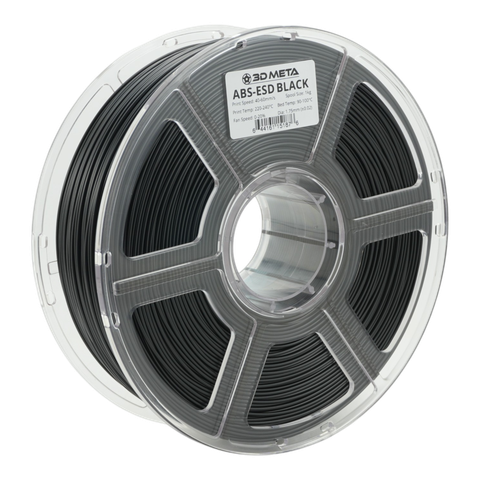
Brand:3D META
3D META Electrostatic-Dissipative ABS 3D Printing Filament
At JB Hi-Fi In stock

Same price since 6 Nov
Unchanged since we started tracking
We may earn a commission at no cost to you. How it works
Price history
Tracking since 6 Nov · 12 days
The price hasn't changed since we started tracking it. We'll show its history once it does.
About this product
- Brand
- 3D META
- Category
- Electronics > Print, Copy, Scan & Fax > 3D Printer Accessories > Filaments
ABS-ESD 3D Printing Filament
3D META's ABS-ESD 3D printing filament is a specialised, electrostatic discharge-safe ABS engineered for printing parts that must safely handle sensitive electronic components. By blending premium ABS with conductive additives, ABS-ESD achieves a controlled surface resistivity that prevents the build-up of static charges, protecting circuit boards, semiconductors, and ESD-sensitive devices. Combining the mechanical strength and heat resistance of ABS with reliable ESD performance, this filament is the ideal choice for jigs, trays, fixtures, and enclosures used in electronics manufacturing, repair, and assembly. Like all 3D META filaments, ABS-ESD is manufactured to strict quality standards and supplied on recyclable plastic spools.
Key Features of ABS-ESD 3D Printing Filament
- ESD-Safe Performance: Engineered with a surface resistivity in the 10 -10 Ohm range, ABS-ESD safely dissipates static charges to protect sensitive electronics.
- Manufactured with High-Quality Materials: Premium ABS base resin combined with carefully dispersed conductive additives for consistent ESD performance across the entire spool.
- High Strength and Durability: Retains the impact resistance and rigidity of standard ABS, making it suitable for functional production tooling.
- High Heat Resistance: Glass transition temperature around 100oC means parts hold their shape in warm assembly environments and under repeated handling.
- Consistent Conductive Dispersion: Uniform distribution of conductive additives delivers stable ESD properties from layer to layer and part to part.
- Excellent Layer Adhesion: Strong inter-layer bonding produces durable parts that hold up to repeated mechanical use.
- Strict QA Manufacturing: Every spool is tested for diameter consistency and verified for ESD performance.
Applications for ABS-ESD 3D Printing Filament
ABS-ESD is purpose-built for environments where uncontrolled static electricity can damage components or contaminate processes:
- Electronics Handling Trays and Jigs: Print custom carriers, sorting trays, and assembly jigs that protect PCBs and components from static damage.
- PCB Fixtures and Test Beds: Hold and locate boards during testing, inspection, and rework without risking ESD events.
- Enclosures for Sensitive Electronics: Print housings, casings, and covers for ESD-sensitive instruments and prototypes.
- Industrial Tooling: End-of-arm tooling, vacuum cups, and assembly line fixtures in electronics manufacturing.
- Cleanroom and Lab Tools: Custom tools and accessories where static discharge could disrupt processes or damage samples.
Note: ABS-ESD requires an enclosed printer with a heated bed (90-110oC) and good ventilation. The conductive additives also make this filament slightly more abrasive than standard ABS - a hardened steel nozzle is recommended for long-term use.
Storage and Drying for ABS-ESD Filament
Conductive-filled materials are particularly sensitive to moisture, which can degrade both print quality and ESD performance:
- Store in a Cool, Dry, Dark Environment: Use airtight containers or vacuum-sealed bags with fresh desiccants at all times.
- Drying Recommendations: Dry ABS-ESD before every print if stored for more than a few days. Use a filament dryer, food dehydrator, or enclosed 3D printer at 70-80oC for 4-6 hours.
Why Choose 3D META's ABS-ESD 3D Printing Filament
- Reliable ESD Performance - Consistent surface resistivity for safe handling of ESD-sensitive components.
- Top-Quality Materials - Premium ABS resin and high-grade conductive additives for stable, repeatable results.
- Strict QA Standards - Tight diameter tolerance and verified ESD performance, batch after batch.
- Fully Tested In-House - Every batch is print-tested before release on real production-style geometries.
- Constant Innovation - 3D META is committed to expanding its engineering-grade filament range and welcomes customer feedback.
Ready to print safer, smarter tooling for your electronics workflow? Order 3D META ABS-ESD filament today and bring professional ESD protection to your 3D printed parts.
Print Settings
Recommended starting settings for 3D META Electrostatic-Dissipative ABS filament. Every printer is different - treat these as a guide and tune for your machine.
Setting Recommended Nozzle Temperature 220-240oC Bed Temperature 100-120oC Print Speed 40-60 mm/s Part Cooling Fan 0-20% Layer Height 0.12-0.3 mm Retraction Distance 1-3 mm Retraction Speed 30-50 mm/s Print Surface Most print surfaces e.g. Glass, META FLEX etc Printing Environment Room Temperature - 40oC Support Material Itself, HIPS Drying (before printing) 70oC for a minimum of 5 hours
Technical Specs
Property Test method Value Filament Material Electrostatic-Dissipative ABS Diameter 1.75 mm (0.02 mm) Net weight 1 kg Spool Recyclable plastic spool Physical Properties Density ISO 1183 1.08-1.1 g/cm3 MFR (250oC / 2.16 kg) ISO 1133 8-12 g/10 min Moisture Absorption ISO 62 <1% Mechanical Properties Tensile Strength ISO 527 35-37 MPa Elongation at Break ISO 527 5-7% Flexural Modulus ISO 527 1300-1500 MPa Flexural Strength ISO 178 60-61 MPa Impact Strength ISO 179 6-7 kJ/m2 Thermal Properties HDT @ 0.455MPa (66 psi) ISO 75 98oC Continuous Use Temerature IEC60216 80oC
FAQs
- What is the surface resistivity of 3D META ABS-ESD?
ABS-ESD provides a surface resistivity in the 10 -10 Ohm range, which falls within the ESD-safe "static dissipative" classification commonly required for handling sensitive electronics.
- Do I need a hardened nozzle to print ABS-ESD?
A hardened steel nozzle is strongly recommended. The conductive carbon additives are mildly abrasive and will wear out a standard brass nozzle more quickly, especially over long production runs.
- What printer settings should I use?
Print at 220-240oC with a heated bed at 100-120oC. An enclosed printer is required for best results. Reduce print speed slightly compared to standard ABS to ensure consistent extrusion of the filled compound.
- Will ABS-ESD shield electronics from EMI?
No. ABS-ESD is designed to dissipate static charge, not to provide electromagnetic interference shielding. For EMI shielding, dedicated conductive or metal-coated materials are required.