

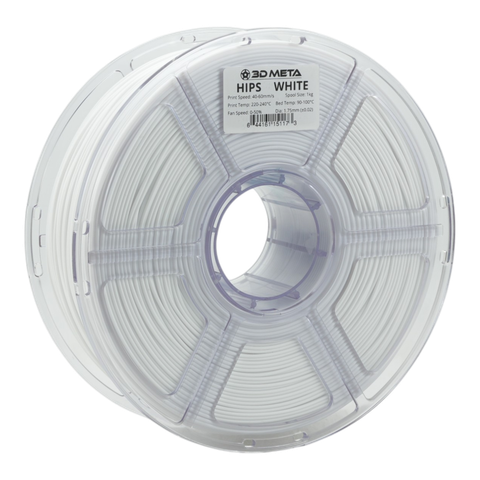
Brand:3D META
3D META HIPS 3D Printing Filament - White - 3D META
At JB Hi-Fi In stock

Same price since 6 Nov
Unchanged since we started tracking
We may earn a commission at no cost to you. How it works
Price history
Tracking since 6 Nov · 12 days
The price hasn't changed since we started tracking it. We'll show its history once it does.
About this product
- Brand
- 3D META
- Category
- Electronics > Print, Copy, Scan & Fax > 3D Printer Accessories > Filaments
Specifications
- Colour
- White
3D META's HIPS 3D printing filament is engineered with high-quality High Impact Polystyrene (HIPS), offering excellent strength, durability, and versatility for a wide range of printing applications. Known for its smooth surface finish and exceptional printability, HIPS 3D printing filament is often used as both a standalone material and a dissolvable support material for complex prints, especially in conjunction with ABS filaments. This filament excels in producing high-quality, detailed prints with superior dimensional stability and minimal warping, making it an excellent choice for hobbyists, engineers, and professional designers alike.
Key Features of HIPS 3D Printing Filament:
- High-quality Composition: HIPS 3D printing filament is manufactured using premium raw materials, ensuring a consistent and reliable printing experience. This filament offers exceptional strength and impact resistance, making it suitable for robust and functional parts.
- Smooth Finish: Prints produced with HIPS filament have a smooth, matte surface finish, ideal for applications where aesthetics are important. Its ability to be easily sanded, painted, or glued allows for further post-processing customization.
- Exceptional Solubility in Limonene: One of the standout features of HIPS 3D printing filament is its solubility in limonene, making it an ideal support material for complex dual-extrusion prints. This allows users to print intricate designs with overhangs and internal structures that can be effortlessly removed by dissolving the HIPS supports in limonene.
- Dimensional Stability and Minimal Warping: HIPS filament exhibits excellent dimensional stability during the printing process, reducing the risk of warping and cracking. This makes it easier to achieve high-quality results even with challenging designs.
- Ease of Printing: HIPS 3D printing filament is known for its easy printability, requiring moderate print bed temperatures and offering strong layer adhesion. It's compatible with most standard FDM 3D printers equipped with a heated bed.
Applications for HIPS 3D Printing Filament:
HIPS 3D printing filament is highly versatile, making it suitable for a range of applications. It's commonly used for prototyping, model making, and functional parts that require high impact resistance. Additionally, its compatibility with ABS makes it a preferred support material for complex, multi-part prints, as it can be easily dissolved post-printing, leaving the primary print intact and free from imperfections. Whether used alone or as a support material, HIPS provides the reliability and quality needed for both creative and industrial projects.
Storage and Drying for HIPS 3D Printing Filament:
To maintain optimal print quality, store HIPS 3D printing filament in a cool, dry place, preferably sealed in an airtight container with desiccants to prevent moisture absorption. HIPS is hygroscopic, meaning it can absorb moisture from the air, which may affect its print performance. If moisture absorption occurs, drying the filament using a dedicated filament dryer or a low-temperature oven set between 80 for 5 hours can restore its optimal printing condition.
Why Choose 3D META's HIPS 3D Printing Filament?
3D META's HIPS 3D printing filament is rigorously tested and manufactured under strict quality assurance standards to deliver consistent, reliable performance. Whether you are a hobbyist creating detailed models or a professional needing a dependable support material for complex prints, our HIPS filament provides the strength, ease of use, and versatility you need. Explore the capabilities of HIPS 3D printing filament with 3D META and elevate your printing projects with confidence!
Print Settings
Recommended starting settings for 3D META HIPS filament. Every printer is different - treat these as a guide and tune for your machine.
Setting Recommended Nozzle Temperature 220-240oC Bed Temperature 80-110oC Print Speed 40-60 mm/s Part Cooling Fan 0-50% Layer Height 0.12-0.3 mm Retraction Distance 1-3 mm Retraction Speed 30-50 mm/s Print Surface Most print surfaces e.g. Glass, META FLEX etc Printing Environment Room Temperature - 40oC Support Material Itself - completely soluble in limonene Drying (before printing) 80oC for a minimum of 5 hours
Technical Specs
Property Test method Value Filament Material HIPS Diameter 1.75 mm (0.02 mm) Net weight 1 kg Spool Recyclable plastic spool Physical Properties Density ISO 1183 1.04-1.06 g/cm3 MFR (250oC / 2.16 kg) ISO 1133 6-9 g/10 min Moisture Absorption ISO 62 1% Mechanical Properties Tensile Strength ISO 527 28.5-29.5 MPa Elongation at Break ISO 527 6-6.5% Flexural Modulus ISO 527 1500-1650 MPa Flexural Strength ISO 178 46.5-49 MPa Impact Strength ISO 179 7-8 kJ/m2 Thermal Properties HDT @ 0.455MPa (66 psi) ISO 75 88oC
Download the full HIPS Technical Data Sheet (PDF).
FAQ's
Q: What is HIPS 3D printing filament, and what is it commonly used for?
A: HIPS (High Impact Polystyrene) 3D printing filament is a durable, impact-resistant thermoplastic known for its smooth surface finish and excellent printability. It's commonly used for creating models, prototypes, and functional parts. HIPS also serves as a dissolvable support material for complex prints, especially when used with ABS filament.
Q: Why is HIPS often used as a support material?
A: HIPS 3D printing filament dissolves in limonene, making it an ideal support material for dual-extrusion 3D printing. This allows for easy removal of supports from complex prints without damaging the main part, which is particularly useful for intricate designs and internal structures.