

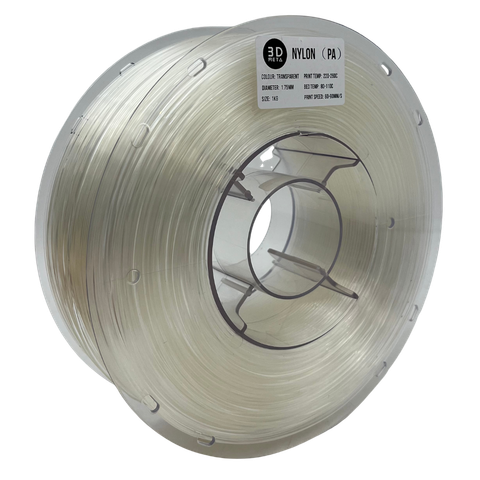
Brand:3D META
3D META PA Nylon 3D Printing Filament – Transparent
At JB Hi-Fi In stock

Same price since 6 Nov
Unchanged since we started tracking
We may earn a commission at no cost to you. How it works
Price history
Tracking since 6 Nov · 12 days
The price hasn't changed since we started tracking it. We'll show its history once it does.
About this product
- Brand
- 3D META
- Category
- Electronics > Print, Copy, Scan & Fax > 3D Printer Accessories > Filaments
Specifications
- Colour
- Transparent
3D META's PA (nylon) 3D printing filament is crafted from high-quality polyamide materials, delivering exceptional strength, durability, and flexibility that set it apart from other filaments. Known for its high impact resistance, PA (nylon) 3D printing filament is ideal for creating functional parts, mechanical components, and prototypes that require superior toughness and wear resistance. With excellent layer adhesion and minimal warping, our PA (nylon) filament ensures consistent, reliable, and high-performance prints that you can trust for demanding applications.
Key Features of PA (Nylon) 3D Printing Filament:
- Superior Strength and Durability: PA (nylon) 3D printing filament is renowned for its exceptional tensile strength, making it suitable for printing parts that need to endure high stress, such as gears, hinges, and tool handles.
- Excellent Flexibility and Impact Resistance: Unlike more rigid filaments, PA (nylon) offers excellent flexibility and can absorb impact without breaking, making it a top choice for functional parts that require resilience.
- Low Warping and High Layer Adhesion: Our PA (nylon) 3D printing filament provides outstanding bed and layer adhesion, minimizing warping and deformation during the printing process.
- Resistance to Chemicals and Abrasion: PA (nylon) filament is highly resistant to chemicals, oils, and abrasion, ensuring long-lasting performance even in harsh environments.
- Quality Manufacturing Standards: Produced under strict quality assurance protocols, our PA (nylon) 3D printing filament delivers consistent diameter, color, and mechanical properties, ensuring a reliable print every time.
Applications for PA (Nylon) 3D Printing Filament:
Thanks to its superior mechanical properties, PA (nylon) 3D printing filament is highly versatile and can be used in a variety of applications. It is commonly used for creating functional prototypes, custom mechanical parts, gears, bearings, and other components that require high strength and wear resistance. Its flexibility also makes it ideal for printing items like living hinges and other movable parts.
Storage and Drying for PA (Nylon) 3D Printing Filament:
PA (nylon) is hygroscopic, meaning it absorbs moisture from the air, which can negatively affect print quality. To maintain optimal performance, store your PA (nylon) 3D printing filament in a cool, dark, and dry place, preferably sealed in an airtight container with desiccants. If the filament absorbs moisture, it can be dried using a filament dryer, food dehydrator, or a heated enclosure set to 70-80oC for 6-8 hours.
Why Choose 3D META's PA (Nylon) 3D Printing Filament?
At 3D META, we are dedicated to delivering the highest quality materials. Our PA (nylon) 3D printing filament is manufactured with strict quality controls, ensuring consistent performance and reliable prints. We rigorously test each spool in-house, so you can trust that our PA (nylon) filament will meet your expectations for even the most demanding projects. Explore the versatility and durability of PA (nylon) 3D printing filament from 3D META and elevate your 3D printing experience today.
Print Settings
Recommended starting settings for 3D META PA (Nylon) filament. Every printer is different - treat these as a guide and tune for your machine.
Setting Recommended Nozzle Temperature 220-260oC Bed Temperature 80-110oC Print Speed 40-60 mm/s Part Cooling Fan 20-50% Layer Height 0.12-0.3 mm Retraction Distance 3-5 mm Retraction Speed 30-50 mm/s Print Surface Most print surfaces e.g. Glass, META FLEX etc Printing Environment Room Temperature - 40oC Support Material Itself, PVA Drying (before printing) 80oC for a minimum of 12 hours
Technical Specs
Property Test method Value Filament Material PA (Nylon) Diameter 1.75 mm (0.02 mm) Net weight 1 kg Spool Recyclable plastic spool Physical Properties Density ISO 1183 1.01-1.06 g/cm3 MFR (250oC / 2.16 kg) ISO 1133 2-5 g/10 min Moisture Absorption ISO 62 3.2% Mechanical Properties Tensile Strength ISO 527 55-58 MPa Elongation at Break ISO 527 32-36% Flexural Modulus ISO 527 1350-1450 MPa Flexural Strength ISO 178 84-87 MPa Impact Strength ISO 179 86.5-87 kJ/m2 Thermal Properties HDT @ 0.455MPa (66 psi) ISO 75 85oC
Download the full PA (Nylon) Technical Data Sheet (PDF).
FAQ's
Q: What are the main benefits of using PA (nylon) 3D printing filament?
A: PA (nylon) 3D printing filament offers superior strength, flexibility, impact resistance, and excellent chemical and abrasion resistance, making it ideal for functional parts, mechanical components, and prototypes.
Q: Is PA (nylon) 3D printing filament hygroscopic, and how should I store it?
A: Yes, PA (nylon) filament is highly hygroscopic and absorbs moisture from the air, which can affect print quality. Store it in a sealed, airtight container with desiccants or in a filament dryer to keep it dry.
Q: Is PA (nylon) filament compatible with support materials?
A: Yes, PA (nylon) can be printed with PVA or HIPS as support materials, which are easily dissolvable, making it convenient to print complex geometries with overhangs.