

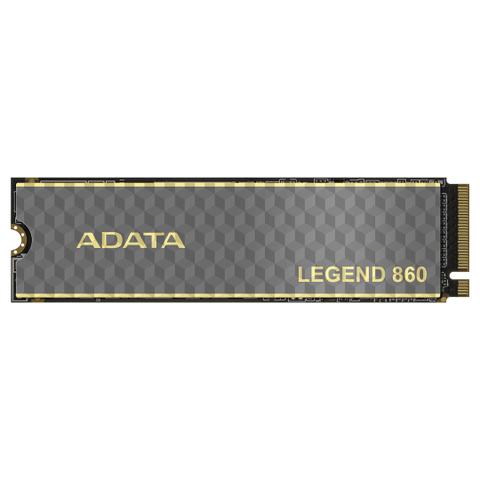

ADATA Legend 860 NVMe PCIe Gen4 SSD 2TB
We may earn a commission if you buy; it doesn't change your price. Check the price at PC Case Gear before you buy. How we make money
Price history
Tracking since today
The price hasn't changed since we started tracking it. We'll show its history once it does.
Available at 2 stores
Stores may pay us a commission when you buy; it doesn't affect the order or your price. Learn more
- PC Case Gear This page $529 Cheapest In stock Checked todayBuy
- PLE $549 In stock Checked yesterday Buy

About this product
- Brand
- ADATA
- Store
- PC Case Gear
- Category
- Electronics > Electronics Accessories > Computer Components > Storage Devices > Solid State Drives
- SKU
- SLEG-860-2000GCS
Specifications
- Capacity
- 2TB
The ADATA Legend 860 2TB is a PCIe Gen4 M.2 SSD offering fast performance with sequential read speeds up to 6,000MB/s and write speeds up to 5,000MB/s. Compatible with both PCs and PS5 consoles, it also includes a slim aluminum heatsink for effective heat dissipation.
Features

LEGEND 860 PCIe Gen4 x4 M.2 2280 Solid State Drive
Powerful and Audacious
- PCIe Gen4 x4 transmission interface
- Up to 6,000/5,000MB/s sequential read/write speed
- Big Capacity up to 2000GB
- Supports latest Intel and AMD platforms
- 5-year warranty
- Heat sink Dissipation
- Expand PS5 Storage
- Encryption mechanism
- SLC Caching
- Host Memory Buffer
- nvm EXPRESS NVMe 1.4
- LDPC ECC Technology
*Download SSD Toolbox for the latest Firmware to optimise performance and obtain other value-added functions.
Imagine it, Achieve it Instantly
The LEGEND 860 boasts a sequential read/write speed of 6,000/5,000MB per second, 3 times faster than standard PCIe Gen3 SSDs and 10 times faster than SATA SSDs, and it is fully backward compatible with current PCIe 3.0 platforms. This drive provides excellent output for mid-to-high-end productions such as film and television animation, machine learning, and product modelling!
- LEGEND 860 - Read: 6,000MB/S, Write: 5,000MB/s
- Normal PCIe Gen3 SSD - Read: 1,800MB/s, Write: 1,200MB/s

Expand PS5 Storage Capacity
The LEGEND 860 utilises a PCIe 4.0 transmission interface and can be installed in the PS5 as an expansion hard drive to alleviate PS5 storage insufficiency issues. Not only does the LEGEND 860 fit perfectly into the PS5'a drive slot, it also provides a smooth and no-lag gaming experience while enjoying triple A masterpieces.
*According to Sony, even if the read and write speed is higher than the official standard, not all games can actually experience the same performance as the PS5 console's built-in SSD.

Back Up an Entire Resource Library
Powerful performance no matter the file size. The LEGEND 860 is available in a spacious 2000GB capacity and utilises a variety of data protection and correction technologies to greatly increase its Total Bytes Written volume (TBW) and durability to meet the needs of various storage applications.

Beyond Elite
LEGEND 860 utilises a SLC cache algorithm and HMB (Host Memory Buffer) technology to take advantage of caching and adopts LDPC (Low Density Parity Check Code) error correction mechanism to ensure the accuracy of data transmission and file security.

5 Year Warranty for Peace of Mind
The LEGEND series of solid-state hard drives are constructed with carefully selected high-quality components which can withstand the test of time. Rigorously verified and tested, the LEGEND 860 comes with a 5-year warranty to provide you with peace of mind!

SSD Toolbox Value-Added Software for Real-Time Status Monitoring
SSD Toolbox ensures users utilise the latest Firmware version for the best performance and employs Self-Monitoring, Analysis and Reporting Technology (S.M.A.R.T.) to understand the health and remaining lifespan of SSDs, as well as the current operating temperature and storage capacity, so that users can track of SSD status at any time.