

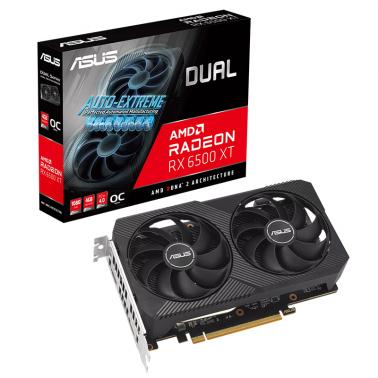

Asus Radeon RX 6500 XT Dual OC 4G V2 Graphics Card (DUAL-RX6500XT-O4G-V2)
Price$209
Out of stock at Umart
Price checked today
We may earn a commission if you buy; it doesn't change your price. Check the price at Umart before you buy. How we make money
Price history
Tracking since today
The price hasn't changed since we started tracking it. We'll show its history once it does.
About this product
SPECIFICATIONS:
| Graphic Engine | Radeon RX 6500 XT |
| Bus Standard | PCI Express 4.0 |
| OpenGL | OpenGL®4.6 |
| Video Memory | 4GB GDDR6 |
| Engine Clock | OC mode: up to 2820 MHz(Boost Clock)/ up to 2670 MHz(Game Clock) Gaming mode: up to 2820 MHz(Boost Clock)/ up to 2650 MHz(Game Clock) |
| Stream Processors | 1024 |
| Memory Speed | 18 Gbps |
| Memory Interface | 64-bit |
| Resolution | Digital Max Resolution 7680 x 4320 |
| Interface | Yes x 1 (Native HDMI 2.1) Yes x 1 (Native DisplayPort 1.4a) HDCP Support Yes (2.3) |
| Maximum Display Support | 2 |
| NVlink/ Crossfire Support | No |
| Accessories | 1 x Speedsetup Manual |
| Software | ASUS GPU Tweak III & Drivers: please download all software from the support site. |
| Dimensions | 201 x 128 x 40 mm 7.9 x 5.03 x 1.57 inch |
| Recommended PSU | 500W |
| Power Connectors | 1 x 6-pin |
| Slot | 2 Slot |
| Note | * Our wattage recommendation is based on a fully overclocked GPU and CPU system configuration. For a more tailored suggestion, please use the “Choose By Wattage” feature on our PSU product page: https://rog.asus.com/event/PSU/ASUS-Power-Supply-Units/index.html * Crossfire Support for DirecX® 12 and Vulkan® * ‘Game Clock’ is the expected GPU clock when running typical gaming applications, set to typical TGP (Total Graphics Power). Actual individual game clock results may vary. * ‘Boost Clock’ is the maximum frequency achievable on the GPU running a bursty workload. Boost clock achievability, frequency, and sustainability will vary based on several factors, including but not limited to: thermal conditions and variation in applications and workloads. |