

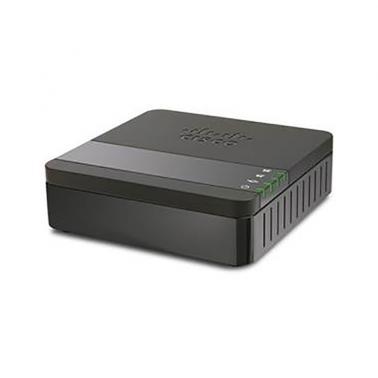
Cisco Analog Telephone Adapter (ATA191-K9)
Out of stock at MSY
Price checked today
We may earn a commission if you buy; it doesn't change your price. Check the price at MSY before you buy. How we make money
Price history
Tracking since today
The price hasn't changed since we started tracking it. We'll show its history once it does.
About this product
Cisco ATA 191 K9 Analog Telephone AdapterThe Cisco ATA 191 Analog Telephone Adapter is a 2-port handset-to-Ethernet adapter that brings traditional analog telephony devices into the IP world.Product OverviewThe Cisco ATA 191 Analog Telephone Adapter turns traditional telephone, fax, and overhead paging communications devices into IP devices for greater cost-effectiveness. Customers can take advantage of IP telephony applications by connecting their analog devices to Cisco analog telephone adapters.The Cisco ATA 191 Analog Telephone Adapter is the preferred solution to address the needs of customers who connect to enterprise networks, small offices, or the emerging unified communications as a service from the cloud. It has two standard FXS ports, which can be configured independently as two Session Initiation Protocol (SIP) registrations. With the ATA 191, customers can protect and extend their existing investment in analog systems, as well as smooth their migration to pure voice over IP in an affordable and reliable way.The Cisco ATA 191 Analog Telephone Adapter is designed to work with Cisco call control systems.FeatureBenefitVoice qualityOffers clear, natural-sounding voice quality via advanced preprocessing, high-performance echo cancellation, Voice Activity Detection (VAD), and Comfort Noise Generation (CNG)Central provisioning and configurationEases deployment via a Cisco Unified Communications Manager central interfaceSecurityProvides a complete security solution for both media and signalingProblem reporting (PRT)Improves serviceability with a dedicated PRT button for problem reporting and log collectionIPv6Enables an IPv4/IPv6 dual stack to help migration to IPv6Specifications:Physical dimensions (HWD)3.9 x 3.9 x 1 in. (100 100 28 mm)Weight4.7 oz (132.1 g)HardwareInterface: Two RJ11 FXS ports, one 10/100 Mbps RJ-45 Ethernet port,power button: reset and PRTLED indicators: Power, Network, Phone 1, Phone 2, PRTWall mountableSubscriber Line Interface Circuit (SLIC)Ring voltage: 40 to 90 Vpk configurableRing frequency accuracy: 1%Ring waveform: Trapezoidal or sinusoidalMaximum ringer load: 3 Ringer Equivalence Numbers (RENs)On-hook voltage (tip and ring): -46 to -56VOff-hook current: 25mA +/-10%Terminating impedance: 600 ohm resistive, 900 ohm resistive, or 220 ohm + 820 ohm120 nF complex impedanceFrequency response: 300 to 3400 HzReturn loss (600 ohm, 300 to 3400 Hz): up to 26 dBIdle channel noise: <-65 dBm 0pLongitudinal balance: 58 dB (typical)Voice quality Mean Opinion Score (MOS): >4.0Voice quality jitter: <150msNetworkingMAC addressIPv4 onlyIPv6 onlyIPv4/IPv6 dual stackSession Initiation Protocol (SIP)Transmission Control Protocol (TCP)User Datagram Protocol (UDP)Real Time Protocol (RTP)Real Time Control Protocol (RTCP)HTTPSecure HTTP (HTTPS)Trivial File Transfer Protocol (TFTP)Address Resolution Protocol (ARP)DNS A and AAAA recordsDynamic Host Configuration Protocol (DHCP) clientInternet Control Message Protocol (ICMP)Simple Network Time Protocol (SNTP)Cisco Discovery Protocol (CDP)Link Layer Discovery Protocol (LLDP)Quality of Service (QoS)IEEE 802.1p/Q (QoS and VLAN tagging)Differentiated Services (DiffServ) / Type of Service (ToS)TelephonyCall forwarding: No answer, busy, and allCall hold and resumeCaller ID generation (name and number): Bellcore, BT, and European Telecommunications Standards Institute (ETSI)Caller ID with name and numberCall pickup and group pickupCall transferCall waitingConferenceConfigurable ring frequencyCountry-specific tones and cadencesDisconnect toneDistinctive ringing: Calling and called numberForced Authorization Code (FAC)/Client Matter Code (CMC)Failover and fall backFlash hook timerHook flash event signalingHotline and warm line callingMessage Waiting Indicator (MWI) tonesMusic on holdOff-hook warning tonePolarity controlRedialShare linesSpeed dialTip and ring voltage adjustment settingVisual Messaging Waiting Indicator (VMWI) using Frequency Shift Keying (FSK)AudioCodec: G.711 a-law, G.711 -law, G.729a, G.729abFull duplex audioEcho cancellationVoice activity detectionSilence suppressionComfort noise generationAdaptive jitter bufferFrame loss concealmentAdjustable audio frames per packetCall progress tone generationImpedance and gain adjustmentDynamic audio payloadFax and modemReal-time fax over IP via T.38 fax relay (Group 3)Fax pass-through via G.711 (Group 3)Fax tone detection and pass-throughAuto negotiation on transmission rateProvisioning and managementCentral configurationInteractive Voice Response (IVR)Automated provisioning and upgrading via HTTP and TFTPSSH accessNonintrusive, in-service upgradesReport generation and event loggingDedicate PRT buttonSupport RTP statisticsSyslog (multilevel granularity)Dual imageSecuritySystem reset to factory defaultPassword-protected administrator access authorityProvisioning, configuration, and authenticationHTTPS with factory-installed client certificateAdvanced Encryption Standard (AES) encryptionSIP over Transport Layer Security (TLS) 1.1 and 1.2Secure (encrypted) calling using Secure RTP (sRTP)Encrypted TFTP configuration filesImage authenticationSecure bootSecure Shell (SSH)PowerDC input voltage: 5V DC at 2.0A maximumPower consumption: 5WSwitching type (100 to 240V) automaticPower adapter: 100 to 240V and 50 to 60 Hz (26 to 34 VA) AC input, with 6-ft (1.8-m) cordReliabilityMean Time Between Failures (MTBF): 300,000 hoursOperating temperature: 32 to 104F (0 to 40C)Nonoperating temperature: 14 to 140F (-10 to 60C)Humidity: Operating 10% to 90%, noncondensing; nonoperating 10% to 95%, noncondensingCompliance (regulatory)CE markings per directives 2014/30/EU and 2014/35/EUCompliance (safety)UL 60950 Second EditionCAN/CSA-C22.2 No. 60950 Second EditionIEC 60950-1:2005 (Second Edition) + A1:2009 + A2:2013 and/or AS/NZS 60950.1:2015Compliance (EMC)AS/NZS CISPR 32:2015 Class BCISPR 32: 2015 Class BEN 55032: 2015 Class BEN 61000-3-2: 2014 Class AEN 61000-3-3: 2013EN 55024:2010+A1: 2015EN 61000-4-2: 2009EN 61000-4-3: 2006+A1:2008+A2:2010EN 61000-4-4: 2012EN 61000-4-5: 2014EN 61000-4-6: 2014+AC2015EN 61000-4-8: 2010EN 61000-4-11: 2004FCC Part 15, Subpart BANSI C63.4-2014ICES-003 Issue 6: 2016ANSI C63.4-2014VCCI-TECHNICAL REQUIREMENTS (VCCI-CISPR 32: 2016) /CISPR 32: 2015 class B