

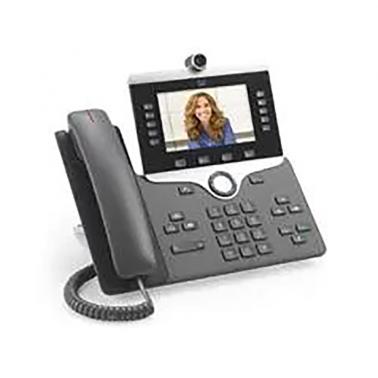

Cisco IP Phone 8865 Charcoal (IP Phone 8865)
Out of stock at Umart
Price checked today
We may earn a commission if you buy; it doesn't change your price. Check the price at Umart before you buy. How we make money
Price history
Tracking since today
The price hasn't changed since we started tracking it. We'll show its history once it does.
About this product
- Brand
- Cisco
- Store
- Umart
- Category
- Electronics > Communications > Telephony > Corded Phones > VoIP Phones
- SKU
- 54352
Specifications
- Colour
- Charcoal
Cisco IP Phone 8865 Charcoal
Ergonomic design · The phone offers an easy-to-use interface and provides a traditional telephony-like user experience
Graphical display · The 800 × 480, 24-bit color, 5-in. WVGA display provides scrollable access to calling features and text-based XML applications
Video
720p HD video (encode and decode)
H.264 and Cisco Application Visibility and Control (AVC)
Handset
The handset is a standard wideband-capable audio handset (connects through an RJ-9 port)
The standard coiled cord has a custom end for concealed cable routing beneath the phone (cord length is approximately 21 in. [55 cm] coiled and up to 72 in. (183 cm) extended)
The handset is hearing aid-compatible (HAC) and meets Federal Communications Commission (FCC) loudness requirements for the Americans with Disabilities Act (ADA). You can achieve Section 508 loudness requirements by using industry-standard inline handset amplifiers such as Walker Equipment W-10 or CE-100 amplifiers. The dial pad is also ADA-compliant
Speakerphone
The full-duplex speakerphone gives you flexibility in placing and receiving calls with hands free.For added security, the audible dual tone multifrequency (DTMF) tones are masked when the speakerphone mode is used.
Analog headset
The analog headset jack is a standard wideband-capable RJ-9 audio port
AUX port
You can use an auxiliary port to support electronic hookswitch control with a third-party headset connected to it
External audio ports
The phone has a 3.5-mm stereo line in/out jack (for optional external headset, speakers, or headphones)
USB
Two USB ports enhance the usability of call handling by enabling wired or wireless headsets, in addition to providing charging capability to mobile devices such as smartphones or tablets
A side USB port provides up to 500mA power output at 5V or 2.5W
A back USB (in yellow) port provides 500mA power output and is upgradable to support up to 2.1A power output at 5V or 10.5W
Ethernet switch
An internal 2-port Cisco Ethernet switch allows for a direct connection to a 10/100/1000BASE-T Ethernet network (IEEE 802.3i/802.3u/802.3ab) through an RJ-45 interface with single LAN connectivity for both the phone and a co-located PC
The system administrator can designate separate VLANs (IEEE 802.1Q) for the PC and phone, providing improved security and reliability of voice and data traffic
Bluetooth
The phone offers Bluetooth 4.1 LE, Enhanced Data Rate (EDR) Class 1 technology (up to 66-ft [20m] range)
Hands-Free Profile (HFP) is supported for untethered headset connections and voice communications
Phone Book Access Profile (PBAP) is supported for phone book object exchange between devices
Wi-Fi client
As an alternative to wired Ethernet, the 8865 supports a Wi-Fi radio with integrated antenna enabling connectivity to a Wi-Fi access-point infrastructure, thereby saving on the labor costs of pulling Ethernet cables to every work location. Complete Wi-Fi specifications are included in Table 3 later in this document
Keys
The phone has the following keys:
Line keys
Soft keys
Protocols · IEEE 802.11a, 802.11b, 802.11g, 802.11n, and 802.11ac
Frequency bands and operating channels
2.412-2.472 GHz (channels 1-13)
5.180-5.240 GHz (channels 36-48)
5.260-5.320 GHz (channels 52-64)
5.500-5.700 GHz (channels 100-140)
5.745-5.825 GHz (channels 149-161)
IEEE 802.11d is used to identify available channels.
Nonoverlapping channels
2.4 GHz (20-MHz channels): Up to 3 channels
5 GHz (20-MHz channels): Up to 24 channels
5 GHz (40-MHz channels): Up to 9 channels
5 GHz (80-MHz channels): Up to 4 channels
Operating modes
Auto (default), preference to strongest RSSI for 2.4 or 5 GHz
2.4 GHz only
5 GHz only
Data rates
802.11a: 6, 9, 12, 18, 24, 36, 48, and 54 Mbps
802.11b: 1, 2, 5.5, and 11 Mbps
802.11g: 6, 9, 12, 18, 24, 36, 48, and 54 Mbps
802.11n: HT MCS 0, MCS 1, MCS 2, MCS 3, MCS 4, MCS 5, MCS 6, and MCS 7
802.11ac: VHT MCS 0, MCS1, MCS 2, MCS 3, MCS 4, MCS 5, MCS 6, MCS 7, MCS 8, and MCS 9
(MCS 9 available with VHT40 and VHT80 only)
2.4-GHz receiver sensitivity
IEEE 802.11b:
IEEE 802.11g:
IEEE 802.11n HT20:
1 Mbps: -98 dBm
6 Mbps: -95 dBm
MCS 0: -95 dBm
2 Mbps: -96 dBm
9 Mbps: -94 dBm
MCS 1: -92 dBm
5.5 Mbps: -93 dBm
12 Mbps: -93 dBm
MCS 2: -90 dBm
11 Mbps: -91 dBm
18 Mbps: -90 dBm
MCS 3: -87 dBm
24 Mbps: -87 dBm
MCS 4: -83 dBm
36 Mbps: -84 dBm
MCS 5: -78 dBm
48 Mbps: -79 dBm
MCS 6: -77 dBm
54 Mbps: -77 dBm
MCS 7: -75 dBm
5-GHz receiver sensitivity
IEEE 802.11a:
IEEE 802.11n HT20:
IEEE 802.11n HT40:
6 Mbps: -94 dBm
MCS 0: -94 dBm
MCS 0: -91 dBm
9 Mbps: -93 dBm
MCS 1: -91 dBm
MCS 1: -88 dBm
12 Mbps: -92 dBm
MCS 2: -89 dBm
MCS 2: -86 dBm
18 Mbps: -89 dBm
MCS 3: -86 dBm
MCS 3: -83 dBm
24 Mbps: -86 dBm
MCS 4: -82 dBm
MCS 4: -79 dBm
36 Mbps: -83 dBm
MCS 5: -77 dBm
MCS 5: -75 dBm
48 Mbps: -78 dBm
MCS 6: -76 dBm
MCS 6: -73 dBm
54 Mbps: -76 dBm
MCS 7: -74 dBm
MCS 7: -72 dBm
IEEE 802.11ac VHT20:
IEEE 802.11ac VHT40:
IEEE 802.11ac VHT80:
MCS 0: -93 dBm
MCS 0: -90 dBm
MCS 0: -87 dBm
MCS 1: -90 dBm
MCS 1: -87 dBm
MCS 1: -83 dBm
MCS 2: -87 dBm
MCS 2: -85 dBm
MCS 2: -81 dBm
MCS 3: -84 dBm
MCS 3: -82 dBm
MCS 3: -78 dBm
MCS 4: -81 dBm
MCS 4: -79 dBm
MCS 4: -75 dBm
MCS 5: -76 dBm
MCS 5: -73 dBm
MCS 5: -73 dBm
MCS 6: -75 dBm
MCS 6: -72 dBm
MCS 6: -68 dBm
MCS 7: -74 dBm
MCS 7: -72 dBm
MCS 7: -68 dBm
MCS 8: -70 dBm
MCS 8: -67dBm
MCS 8: -64 dBm
MCS 9: -66 dBm
MCS 9: -62 dBm
Transmitter output power
2.4 GHz:
5 GHz:
802.11b: Up to 17 dBm
802.11a: Up to 16 dBm
802.11g: Up to 16 dBm
802.11n HT20: Up to 13 dBm
802.11n HT20: Up to 13 dBm
802.11n HT40: Up to 13 dBm
802.11ac VHT20: Up to 12 dBm
802.11ac VHT40: Up to 12 dBm
802.11ac VHT80: Up to 12 dBm
Antenna
2.4 GHz: 2.08-dBi peak gain
5 GHz: 1.88-dBi peak gain
Access-point support
Cisco Wireless Access Points
Minimum: 7.0.240.0
Recommended: 7.4.121.0, 7.6.110.0, or later
Cisco Aironet Access Points in Autonomous Mode
Minimum: 12.4(21a)JY
Recommended: 12.4(25d)JA2 or later
Cisco Meraki® access points
Wireless security
Authentication:
Encryption:
Wi-Fi Protected Access (WPA) Versions 1 and 2 Personal and Enterprise
40- and 128-bit static Wired Equivalent Privacy (WEP)
EAP-FAST
Temporal Key Integrity Protocol (TKIP) and Message Integrity Check (MIC)
Protected Extensible Authentication Protocol - Microsoft Challenge Handshake Authentication Protocol Version 2 (PEAP-MSCHAPv2)
Advanced Encryption Standard (AES)
Fast secure roaming
802.11r (FT)
Cisco Centralized Key Management (CKM)
QoS
IEEE 802.11e and Wi-Fi Multimedia (WMM)
Traffic Specification (TSPEC)
Traffic Classification (TCLAS)
Enhanced Distributed Channel Access (EDCA)
QoS Basic Service Set (QBSS)
Radar detection
Dynamic frequency selection (DFS) and transmit power control (TPC) according to IEEE 802.11h