

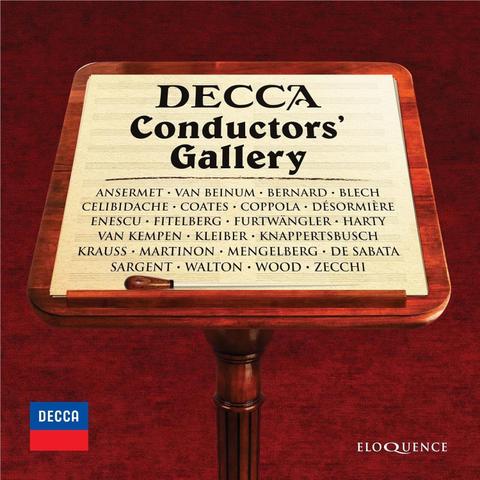

Decca Conductors' Gallery (Box Set)
In stock at JB Hi-Fi
Price checked yesterday
We may earn a commission if you buy; it doesn't change your price. Check the price at JB Hi-Fi before you buy. How we make money
Price history
Tracking since yesterday
The price hasn't changed since we started tracking it. We'll show its history once it does.
About this product
An A-Z of 23 conductors in a feast of classic recordings from Decca's early years - 1929-1949 - including the golden age of it's 'ffrr' technology.
Newly remastered from the best available sources by Mark Obert-Thorn, Ward Marston and Andrew Hallifax, this comprehensively annotated and richly illustrated set features several new-to-CD releases. It is a must-have for any follower of historical recordings.
Spanning almost twenty years, the unique story of this set begins in May 1929 with Decca's first major recording, Delius's Sea Drift - a performance whose merits were obscured at the time by surface noise, but which the latest technology reveals to be a gloriously sympathetic reading of Delius's poignant elegy. Back then, the conductor (Anthony Bernard) was not even printed on the 78 labels; yet, for a later recording in the set, a suite of Handel, the name of Erich Kleiber stands out: a sign of how far the label travelled in it's first twenty years, through some choppy commercial waters, to become a byword for technological excellence and world-class musical artistry drawn from around the globe. The pre-war recordings inevitably centre on British/Irish conducting talent, old and new: Hamilton Harty, dynamic in Haydn and Walton; Walton himself, in a definitive first recording of Façade; atmospheric Vaughan Williams, Elgar and Coates from Henry Wood. One of the rarest items in the set is Bach's Concerto for Two Violins as led by Mengelberg in 1936.
The post-war material includes several great names of the podium from those pre-war days, judiciously picked up by Decca when they might otherwise have been forgotten: Albert Coates whipping up a frenzy in the Russian repertoire he made his own; Clemens Krauss, incandescent in Strauss from Milan and London; Leo Blech's genial 'Surprise' Symphony of Haydn. Senior composer-conductors include Fitelberg in Tchaikovsky's Symphony No. 3 and Enescu in Schumann's Second. Then there are thrilling young podium tyros who were setting London musical life alight in the postwar years: Celibidache's electrifying and wayward Tchaikovsky, Martinon's exquisite Ravel, Coppola's majestic Schumann.
A note from the remastering engineer Andrew Hallifax explains the history behind this first-ever release of Handel choruses conducted by Sir Malcolm Sargent. Mark Obert-Thorn explains his choice of treasures for this box and introduces the history of Decca and it's revolutionary development of 'full frequency range recording' in the late 1940s. Peter Quantrill expands the historical perspective with notes on both Decca and each of the individual conductors in the box.