

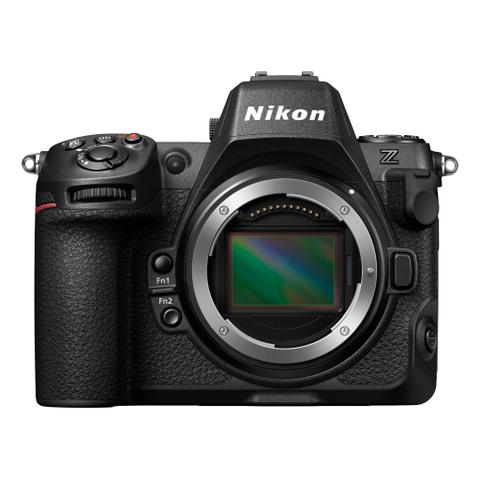

Nikon Z8 Mirrorless Camera (Body Only)
In stock at JB Hi-Fi
Price checked yesterday
We may earn a commission if you buy; it doesn't change your price. Check the price at JB Hi-Fi before you buy. How we make money
Price history
Tracking since yesterday
The price hasn't changed since we started tracking it. We'll show its history once it does.
About this product
Stacked CMOS sensor with minimal rolling shutter distortion
The Z 8 incorporates the same stacked CMOS sensor featuring 45.7 effective megapixels as the Z 9. The world’s fastest*
scanning speed makes it possible to minimize rolling-shutter distortion while eliminating the need for a mechanical shutter.
*As of May 10, 2023, among mirrorless cameras incorporating an image sensor with 30 megapixels or larger, based on Nikon research.
Exquisite image-processing – Expeed 7 Processor.
The Z 8 is equipped with Nikon’s most advanced image-processing engine, EXPEED 7. It processes a vast amount of data and enables next-generation features like the Real-Live Viewfinder, powerful AF, 120fps Pre-Release Capture, High Efficiency RAW, in-camera 8.3K/60p N-RAW, 4K UHD/120p, and more.
Groundbreaking subject detection and AF performance — even better than before
The powerful AF algorithm automatically detects and tracks nine subject types — people (eye, face, head, upper body), dogs, cats, birds, cars, motorcycles, bicycles, trains, and planes. The detection performance in dimly lit situations, such as indoors and at sunsets, has also been enhanced. Together with fast AF calculation and constant, rapid communication between the camera body and the NIKKOR Z lenses, the Z 8 offers high AF performance in a variety of shooting scenes.
The powerful EXPEED 7 engine allows the Z 8 to detect faces even as small as 3% of the frame’s long edge. This is very useful for wedding scenes when you want to shoot the couple in an expansive landscape and keep them in sharp focus. The function also allows videographers to capture a person approaching from a distance, keeping the AF on them as they run toward the camera from a starting point.
*As of May 10, 2023, among mirrorless cameras, based on Nikon research.
Dual card slots give you the options to suit your needs
The Z 8 has two card slots, which give you a choice according to your shooting needs. One slot takes industry-leading CFexpress Type B cards, excellent for fast reading/writing of heavy stills or video data. This slot also accepts XQD memory cards. The second slot takes the more widely available SD (UHS-II) cards, which have a great balance of writing speed and cost.
Extended recording up to 125 min. in 4K UHD/60p*1 and up to 90 min. in 8K UHD/30p*2
The Z 8 enables extended recording up to 125 min. in 4K UHD/60p and up to 90 min. in 8K UHD/30p without overheating. With its smaller and lighter body than the Z 9, it is suitable for demanding all-day weddings and long, fly-on-the-wall documentaries.
*1H.265 8-bit (MOV), [Extended oversampling]: [OFF], [Auto temperature cutout]: [Standard], at 25°C/77°F, using a Nikon MC-CF660G memory card and external power source.
*2H.265 8-bit (MOV), [Auto temperature cutout]: [High], at 25°C/77°F, using a Nikon MC-CF660G memory card and external power source.
Rich tones with increased luminance captured in HEIF, both for stills and time-lapse videos
Landscape/cityscape photographers can now take full advantage of capturing the rich tones of sunset and high luminance of city illumination by shooting in HEIF (High Efficiency Image File). The HEIF format can retain rich tonal gradation with HLG gamma in 10-bit. You can also get an idea of how the HEIF images that you shoot will look on an HDR (HLG)-compatible monitor with the Z 8’s 3000cd/m2 compatible EVF and 900cd/m2 high-luminance image monitor on location. It is also possible to create 8K UHD HLG time-lapse videos in-camera. You can enjoy viewing the HEIF images and footage by connecting the Z 8 to an HDR (HLG)-compatible monitor or television via an HDMI 2.1 cable.
12-bit or 10-bit professional-level video options — all in-camera
Whatever you are shooting, you can achieve maximum creative potential with high-quality grading possibilities. The Z 8 records pristine 12-bit ProRes RAW HQ, Nikon’s proprietary N-RAW video, or 10-bit ProRes 422 HQ internally — no external device required. Full HD proxy files are simultaneously created in-camera when shooting in ProRes RAW and N-RAW, which makes editing the footage a smoother process. Furthermore, you can shoot in N-Log for any of the 12-bit and 10-bit in-camera codecs to get more control over the look of your final footage.
12-bit N-RAW for 8.3K 60p streamlines high-end video production
Nikon’s groundbreaking N-RAW* video format packs all the depth and detail of 12-bit RAW into a file that is half the size of ProRes RAW HQ files. You can work with 8.3K/60p, 5.4K/60p (DX format), 4.1K/120p, or 4K UHD/120p (2.3x crop) footage in compatible editing software to create 8K or 4K video outputs in both DCI and UHD formats. Furthermore, 8K footage gives you the freedom to crop, zoom, and track in post, while still being able to output your finished video in 4K.
* Compatible with Blackmagic Design DaVinci Resolve ver.17.4.6 or later, and Grass Valley EDIUS X ver.10.32 or later.
12-bit ProRes RAW HQ optimizes editing workflow
The Z 8 lets you record 4.1K/60p in 12-bit ProRes RAW HQ, also in-camera. ProRes RAW HQ is a go-to codec for professionals, so it’s practical to use when you are editing videos with footage taken by multiple different cameras and recorders which support the format. You can take advantage of the flexibility in post, including for green-screen chroma key compositing and other digital effects.
ProRes 422 HQ and H.265 available in 10-bit
The Z 8 lets you shoot in 10-bit video files that pack rich depth and detail but are easy to grade and edit on your laptop on the go. ProRes 422 HQ, regarded as an industry standard, is a video format that is compatible with a wide variety of editing software. You can shoot up to 4K UHD/60p and Full HD/120p in 4:2:2 colour sampling with ALL-I intraframe compression to achieve high image quality. You also have the option to shoot in H.265, which supports up to 4K UHD/120p without cropping.
More control over your look with N-Log*1
You can select the tone mode when recording video from SDR, N-Log, and HLG. Nikon’s original N-Log utilizes extensive colour depth and 12-stop 1,300% dynamic range to record rich tones in both the highlights and shadows. You can also take advantage of Nikon’s 3D LUT*2 to help speed up your grading in post.
*1 N-Log is not supported in 8-bit.
*2 Can be downloaded from the Nikon website
High-definition 4K UHD/60p, 50p, 30p, 25p, 24p oversampled from 8K
Sharpness matters, especially on larger monitors. With the Z 8, you can record high-definition 4K UHD/60p, 50p*1 30p, 25p, and 24p oversampled*2 from 8K in 10-bit and 8-bit. Combining this with high-resolution NIKKOR Z lenses creates overwhelmingly immersive 4K videos.
*1 Oversampling expansion is available when the FX-based video format is selected.
*2 For 60p and 50p, [ON] must be selected for [Extended oversampling].
Crystal clear 24-bit/48 kHz linear PCM audio recording
The Z 8 lets you record high-quality audio in 24-bit/48 kHz linear PCM* when shooting video. With uncompressed linear audio, you can record sound clearly with a wider dynamic range.
*H.264 only supports 16-bit AAC 48kHz
Zoom in on your subjects even when using prime lenses — Hi-Res Zoom*
With the Z 8’s Hi-Res Zoom, you can enjoy an extra reach of up to 2× zoom during 4K UHD and Full HD video recording with the touch of a button, even when using prime lenses. Unlike an ordinary digital zoom, it preserves high resolut