

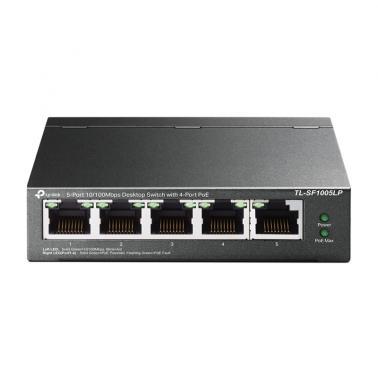
TP-Link 5 Port 10/100Mbps Desktop Switch with PoE - UN/3.40 (SF1005LP)
In stock at MSY
Price checked today
We may earn a commission if you buy; it doesn't change your price. Check the price at MSY before you buy. How we make money
Price history
Tracking since today
The price hasn't changed since we started tracking it. We'll show its history once it does.
About this product
SPECIFICATIONS:HARDWARE FEATURESInterface 5 10/100 Mbps RJ45 Ports (Ports 14 support 802.3af PoE) AUTO Negotiation AUTO MDI/MDIX Network Media 10BASE-T: UTP category 3, 4, 5 cable (maximum 100m) EIA/TIA-568 100 STP (maximum 100m) 100BASE-TX: UTP category 5, 5e cable (maximum 100m) EIA/TIA-568 100 STP (maximum 100m)Fan Quantity FanlessPhysical Security Lock YesExternal Power Supply External Power Adapter (Output: 53.5 V DC / 0.81 A)Packet Forwarding Rate 0.744 MppsPoE Ports (RJ45) Standard: 802.3 af compliant PoE Ports: Ports 14 Power Supply: 41 W Mac Address Table 2KJumbo Frame 2 KBSwitching Capacity 1 GbpsDimensions ( W x D x H ) 3.93.91.0 in (1009825 mm)Max. Power Consumption 1.9 W (220 V / 50 Hz, no PD connected) 47 W (220 V / 50 Hz, with 41 W PD connected) Max. Heat Dissipation 6.48 BTU/h(no PD connected) 160.27 BTU/h(with 41 W PD connected)SOFTWARE FEATURESAdvanced Features Compatible With IEEE 802.3af/at Compliant PDs Extend Mode Button (Ports 14) Priority Mode Button (Ports 12) Mac Address Auto-Learning And Auto-Aging IEEE802.3x Flow Control For Full-Duplex Mode and Backpressure for Half-Duplex Mode Transmission Method Store-And-ForwardOTHERSCertification FCC, CE, RoHSPackage Content TL-SF1005LP Power Adapter Installation Guide Environment Operating Temperature: 040 (32104 ) Storage Temperature: -4070 (-40158 ) Operating Humidity: 1090% RH non-condensing Storage Humidity: 590% RH non-condensing Notes*PoE budget calculations are based on laboratory testing. Actual PoE power budget is not guaranteed and will vary as a result of client limitations and environmental factors.**The speed of the ports in extend mode will downgrade to 10 Mbps. The actual transmission distance may vary due to power consumption of PoE-powered devices or the cable quality and type.