

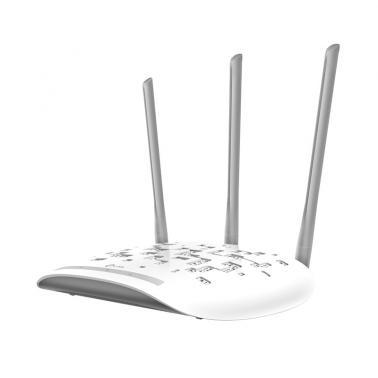
TP-Link N450 Wireless N Access Point - (TL-WA901N)
Out of stock at MSY
Price checked today
We may earn a commission if you buy; it doesn't change your price. Check the price at MSY before you buy. How we make money
Price history
Tracking since today
The price hasn't changed since we started tracking it. We'll show its history once it does.
About this product
SPECIFICATIONS
HARDWARE FEATURESInterface 1 10/100M Ethernet Port(RJ45)Support Passive PoE Button Power On/O Button, Reset Button, WPS ButtonExternal Power Supply 9VDC / 0.85AWireless Standards IEEE 802.11n, IEEE 802.11g, IEEE 802.11bDimensions ( W x D x H ) 7.7 5.3 1.4 in (195 134 36 mm )Antenna Type 3 Fixed Omni-Directional AntennasWIRELESS FEATURESFrequency 2.4 GHzSignal Rate 450 Mbps at 2.4 GHzReception Sensitivity 11g 54M: -76dBm11n 20Mbps: -73dBm 11n 40Mbps: -70dBm Transmit Power CE: <20dBm; FCC: <30dBmWireless ModesAccess Point, Range Extender, Client, Multi-SSIDWireless Functions Enable/Disable Wireless Radio, WDS Bridge, WMM, Wireless Statistics Wireless Security 64/128-bit WEP, WPA/WPA2, WPA-PSK/WPA-PSK2 encryptions DHCP Server, DHCP Client ListQuality of Service WMMManagement SNMPAdvanced Functions Up to 30 meters PoE is supportedOTHERSCertification CE, FCC, RoHSPackage Contents Wireless N Access Point TL-WA901NPower Adapter Passive PoE Power Injector RJ45 Ethernet Cable Quick Installation Guide System Requirements Microsoft Windows 98SE/NT/2000/XP/Vista/7/8/8.1/10, MAC OS,NetWare, UNIX or Linux Internet Explorer 11, Firefox 12.0, Chrome 20.0, Safari 4.0, or otherJava-enabled browser Cable or DSL Modem Subscription with an Internet Service Provider (for Internet access) Environment Operating Temperature: 0C40C (32F104F)Storage Temperature: -40C70C (-40F158F) Operating Humidity: 10%~90% non-condensing Storage Humidity: 5%~90% non-condensing Protocol Support IPv4, IPv6Maximum wireless signal rates are the physical rates derived from IEEE Standard 802.11 specifications. Actual wireless data throughput and wireless coverage are not guaranteed and will vary as a result of 1) environmental factors, including building materials, physical objects, and obstacles, 2) network conditions, including local interference, volume and density of traffic, product location, network complexity, and network overhead, and 3) client limitations, including rated performance, location, connection, quality, and client condition.