

Who decides what you see? How we rank, who pays us, and where we fall short.
In September the corporate regulator, ASIC, warned Australians that comparison websites aren't always what they seem. It's a fair warning, and it applies to us too. So here is how lowerSpendings decides what you see, who pays us, and, just as importantly, what we haven't got right yet.

By Michael Leaney, Founder of lowerSpendings
· 9 min read
What ASIC said
On 22 September, ABC News reported (in a story from AAP) that ASIC had warned shoppers about comparison sites, after launching several court actions. Its focus was financial products such as insurance and loans, but the concerns are general ones.
ASIC commissioner Alan Kirkland told the ABC:
"The products that are listed by many comparison sites are selected and ordered based on what the product providers pay to the comparison sites, and they may not give you a full view of the market."
The report described sites that "only offer a selection of preferred providers", and some that promoted "multiple leads from a single brand". It also gave two examples:
- A court finding. The Federal Court found that Choosi misled consumers over four years from mid-2019. Choosi claimed to compare a range of funeral and life insurance policies, but Hannover Life Re issued all but one of them, and all of them were distributed by Greenstone Financial Services, a company linked with Choosi.
- A new case. ASIC has sued Clark Family Pty Ltd, a lead-generation business. It alleges that up to 70 of its websites misled consumers by claiming to compare options from multiple providers. In Mr Kirkland's words, "In reality, consumers' inquiries were (allegedly) sold to the highest-bidding broker". That case hasn't been decided.
Mr Kirkland also warned about personal information: "Your personal details may be sold to another business, and you may then find yourself the subject of telemarketing calls or marketing emails as a result of your information being sold on."
The report called the court actions "a warning shot across the bow" for the comparison market. His advice to shoppers was sensible: "It's important to actually use a range of comparison sites in order to get a fuller view of the market."
We compare everyday products, not insurance or loans, and we can't speak for anyone else. But each of those concerns is a question you should be able to ask any comparison site, including this one. Here are our answers, checked against the code that runs the site and our own database.
How we rank
Nobody can pay for a better place on lowerSpendings. There are no sponsored or promoted listings. Many stores pay us a commission when you buy through our links, but whether a store pays us, or how much, isn't an input to any of our rankings. Our database doesn't even record commission rates, so nothing could rank by them.
What does decide the order:
- Search orders products by how well their names match what you typed. A product sold by several stores appears once.
- Category pages start with "Popular": products sold by more stores come first (four or more, then three, then two), because those are the ones a comparison is most useful for. Within those groups, the brands that are well known for that kind of product lead, products we're unsure belong in the category go lower, and a good current price breaks ties.
- A product's page lists the stores selling it cheapest first, with ties in alphabetical order. A store we've stopped seeing goes to the bottom, with the day we last saw it.
- The home page shows price drops and a mix of categories, and, if you've used the site before, it's personalised from what you've viewed, liked or set alerts on.
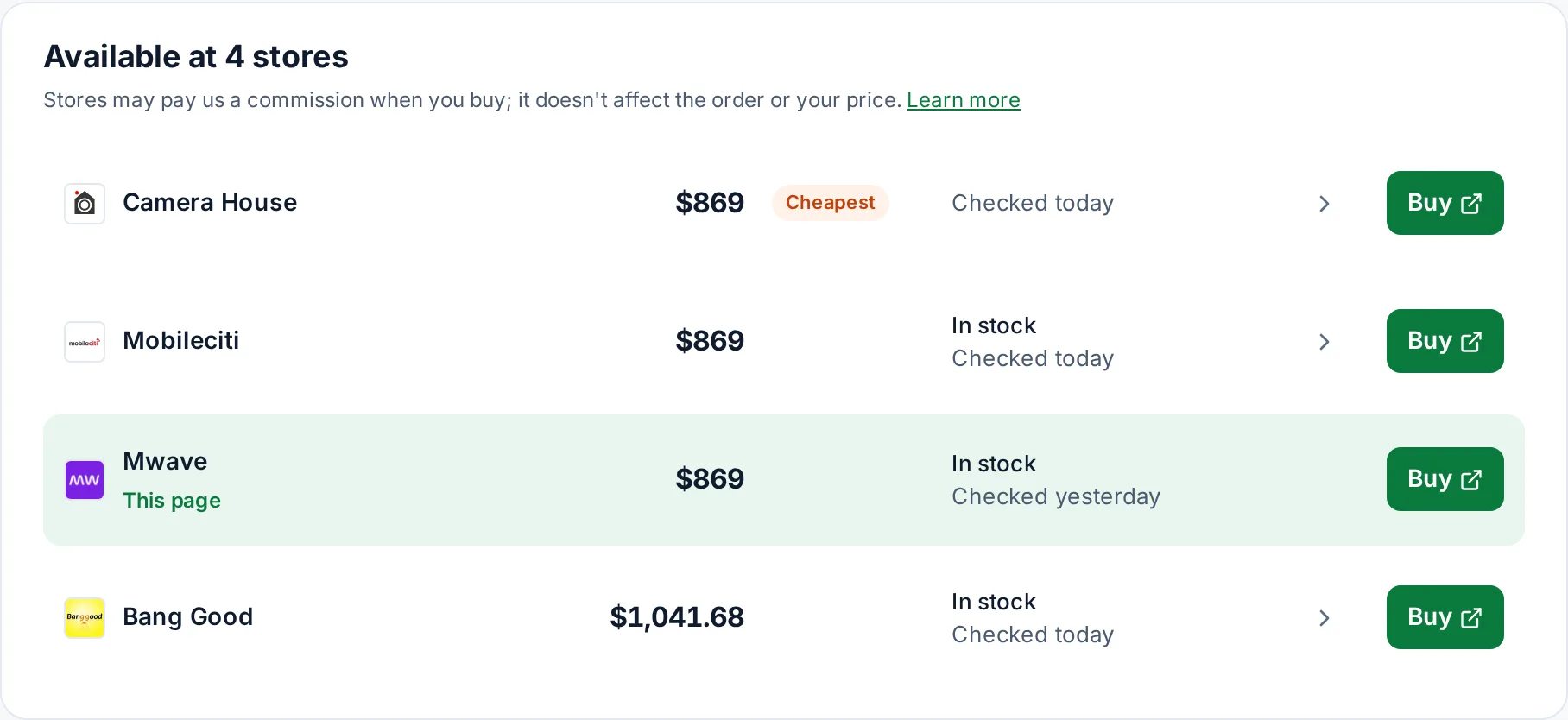
We've written all of this up, with the exact rules for each label, in a page of its own: How we rank.
No page full of one store or one brand
ASIC's concern about "multiple leads from a single brand" is a real risk for any site that ranks by a score, because one big store or one prolific brand can fill a page without anyone intending it. So we cap it. Among the first 24 products on a category page, each row of 12 has at most three from any one store and three from any one brand, as long as there's something else nearly as good to show. Each row of deals on the home page allows only a couple of products per store, and a category's deal preview shows one per store.
Which stores we cover, and which ones pay us
Today, 64 stores have products on lowerSpendings. 60 of them publish their products and prices in a feed through an affiliate network (Commission Factory or Awin), and we may earn a commission when you buy from them through our link. Four pay us nothing: Apple, Costco, Mwave and PLE. We have no affiliate relationship with any of them; we read their prices from their own websites, because comparing computer gear or Apple Watches without them would give you an incomplete picture.
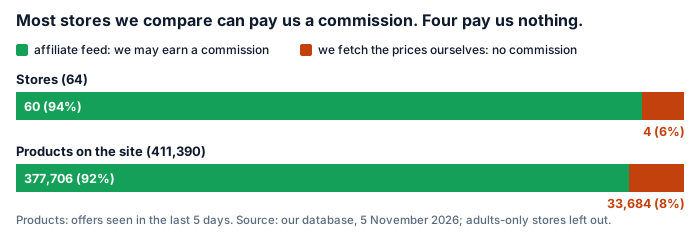
I want to be straight about what that chart means. Most stores are on the site because they publish an affiliate feed: that's how most Australian stores make their product data available to sites like ours. So our coverage leans towards stores with affiliate programmes. It doesn't change the order you see, but it does shape which stores you see at all. We add stores that pay us nothing where we can read their prices reliably and politely, and we'll keep adding them.
There's now a page that lists every store, generated from our database rather than written by hand: Stores we compare. For each one it shows whether we may earn a commission, whether its prices come from a feed or from us, when we last read them and whether it tells us what's in stock.
How we decide a deal is real
A "was" price is only as honest as the history behind it. Ours comes from one source: prices we've seen ourselves, every day we see them.
- No borrowed "was" prices. We don't repeat a store's "RRP" or its own "was" price. Every drop we show is a drop we recorded.
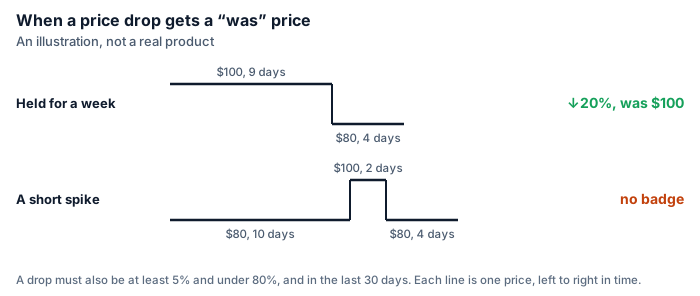
- A "was" price has to have lasted. A price only counts as a "was" price if we saw it on at least seven days before the drop. A price that was raised for a day or two before a "sale" doesn't count.
- Lows are lows we saw. "Lowest price in 90 days" means the lowest we've recorded in 90 days. For products we've tracked for less than a month, the label says so: "Lowest price since we started tracking", with the date we started.
- Old and gone prices are labelled. If a store hasn't updated a price in its feed for more than two weeks, the product says "Price last updated N days ago" and gets no deal label at all. After five weeks we stop showing it. A drop of more than 80% is almost always an error in a feed, so it never becomes a deal.
What we do with your personal information
You can browse, search and compare without an account. If you sign in, it's with Google, and we keep your name, email address, profile photo link and the alerts, likes and choices you make. Our Privacy Policy lists everything we collect, who we share it with and for how long. The parts that matter here:
- We don't sell personal information. Not to stores, brokers or anyone else.
- When you click "Buy", the store and its affiliate network receive a random ID for your visit and the product's ID, so the sale can be credited to us. They don't get your name or email address from us. They may tell us that a sale happened and what commission we earned, but not your name, address or what you bought.
- We only email you about price drops on products you've asked us to watch, at most once a day, and every email has a one-click unsubscribe. No newsletters, no "suggestions", no marketing.
- Ads are Google's. We show ads from Google AdSense, which uses its own cookies and may personalise ads unless you opt out; the Privacy Policy explains how.
- AI services see product data only. We use AI to help categorise and match products. Those services get product names, descriptions and prices, never anything about you.
How we're paid
lowerSpendings is free to use. We earn money in two ways: affiliate commission when you buy through our link from a store that pays one, and ads. You pay the store's normal price either way. Neither changes what we show you or in what order. How we make money has the details.
I have a simple reason to want as many stores as possible on the site, whether they pay us or not: a comparison that leaves out the cheapest store isn't worth much, and a site you can't trust won't be worth visiting for long.
Where we fall short
These are the things I'd want to know if I were deciding whether to trust a comparison site.
- We don't cover every store. Several of Australia's biggest retailers, including JB Hi-Fi, Officeworks, Harvey Norman, Bunnings and Amazon, aren't in our catalogue yet. A lower price may be available somewhere we don't list, so ASIC's advice to check more than one site applies to us too.
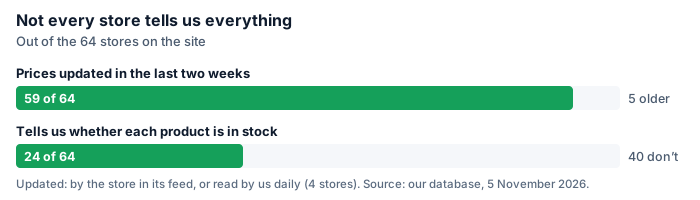
- Some stores' feeds are out of date. On 5 November, five stores hadn't updated their feeds for more than two weeks. Their prices are labelled with their age, but they're less useful than fresh ones.
- Most stores don't tell us about stock. Only 24 of the 64 stores say whether a product is in stock. For the rest, a product can be listed after it sells out, so please check the store.
- Our price history is short. We restarted price tracking on 22 October 2026, so for almost every product our history begins then. Some product pages also show prices from the earlier lowerSpendings (2016 to 2023) as a separate strip, but we never use those for a deal label. Labels such as "lowest in 90 days" will become possible as the history grows.
- Some descriptions are tidied up by AI. One store's feed arrives with its descriptions badly damaged, so an AI model running on our own computers rewrites them, and code checks the rewrite's facts against the original. Those descriptions say "Tidied up with AI from the store's description", with the store's own text one click away.
- Our older deal score is still in use. When you search without typing anything, and as the last tie-breaker on category pages, we still use an older price score that rewards how recently a price changed more than how much it fell. We've measured its flaws and are replacing it, one part of the site at a time.
- Matching isn't perfect. Working out that two stores sell the same product is done mostly by software, and it gets some wrong. If you spot a wrong match, a wrong price or anything else that looks off, please tell us: the contact details are in our Terms.
- Your data requests go by email. You can see and remove your history, alerts and likes on the site, but there's no download or delete-my-account button yet; for those, email us and we'll do it within 30 days.
What we don't do
To answer ASIC's concerns directly:
- We don't sell places in our results, and commission isn't part of any ranking.
- We don't claim to compare stores we don't. Stores we compare lists every one, and says which pay us.
- We don't let one store or one brand fill the top of a page.
- We don't sell your personal information, and we don't pass your details to anyone so they can call or email you.
Trust is earned by being useful and by being honest about the gaps. If you think we've got something wrong, I'd genuinely like to hear about it.
Store and product figures are from our production database on 5 November 2026; a "product" in them is one store's offer seen in the last five days. Adults-only stores are left out, as they are from the store directory. Quotes are from ABC News, "Consumers getting duped by price comparison websites, ASIC warns", 22 September 2026. The screenshot is of the live site, signed out.